Barking House Clearance in Barking
We provide house clearance in Barking for homes that need furniture, household contents and unwanted items removed in an orderly way. The service suits full property clearances, partial room clearances and removals from lofts, garages, sheds and empty rooms. It is designed to help householders, landlords and agents keep the process straightforward, with practical sorting and removal arranged around the type of property and the amount of contents involved.
Our work can include furniture clearance, appliance removal and the handling of mixed household items that no longer need to stay on site. Where a property has accumulated general waste alongside reusable belongings, we can separate items carefully so that the clearance is managed with less disruption. Different rooms often call for different handling, so the approach is adapted to access, item size and how much needs to be cleared.
For a clearer idea of scope, see our house clearance service information and the related home clearance page. If your requirements include a single room, a flat or a larger residential property, the aim is to match the service to the items rather than force a one-size-fits-all approach. Tell us what needs removing and we can discuss the most sensible way to proceed.
Clearance work for different homes and room types
Domestic clearances rarely look the same from one property to another. A top-floor flat may require careful carrying and staged loading, while a family house may involve a wider mix of rooms, furniture and stored belongings. We can clear individual items, bulky furniture and accumulated contents from living rooms, bedrooms, kitchens and storage spaces, always keeping the practical layout of the home in mind.
Where the job is more specific, our flat clearance page and loft clearance page may be relevant. These pages suit customers who want to understand how we handle smaller or harder-to-reach spaces, especially when access is tighter or items have been stored away for some time. The important point is not just removing things quickly, but removing them in a way that fits the property and the contents.
Common residential clearance tasks can include:
- removing unwanted furniture from reception rooms and bedrooms
- clearing cupboards, shelves and built-in storage
- taking away boxed items, mixed household goods and bagged rubbish
- lifting items from lofts, basements, garages and sheds
- sorting reusable, recyclable and disposable material where practical
Furniture removal and disposal choices

Many house clearances in Barking involve heavy or awkward furniture as well as smaller household pieces. Sofas, wardrobes, beds, tables and cabinets often take the most time because they need careful handling through doorways, hallways and stairwells. Our furniture clearance and furniture disposal pages explain the related work, including the removal of unwanted pieces that are no longer needed in the home.
When furniture is still usable, some customers prefer it to be separated from items that are damaged, broken or beyond practical use. That can affect how the clearance is organised and whether the work is best handled as a mixed residential removal or as a more focused furniture job. We do not assume that every item should be treated the same; instead, we look at the materials, condition and access so the work can be managed sensibly.
Two useful things to decide in advance are which large items stay and which ones must go, and whether any pieces need dismantling before removal. This keeps the removal sequence efficient and reduces unnecessary handling. It also helps to group similar items together where possible, especially if a room contains both loose household goods and larger items that need extra care.
Garages, gardens and builders’ waste
Not every domestic clearance is confined to the main rooms of the property. Garages often become a store for mixed items, broken equipment, paint tins, tools and old packaging, while gardens can collect plant waste, outdoor furniture and leftover materials from maintenance work. Our garage clearance and garden clearance pages cover these kinds of outside or semi-outside spaces, where access and item type can vary considerably.
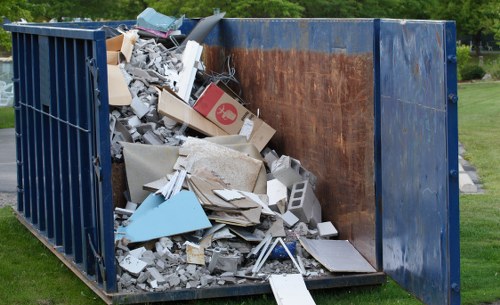
Where the contents come from renovation or repair work rather than everyday household use, the builders waste clearance page may be more relevant. Builders’ waste can include timber offcuts, plasterboard, broken fixtures, packaging and other remnants left after work on the property. The key difference is that this sort of material often needs a more deliberate sorting process than a standard domestic tidy-up, especially when heavier or dustier items are involved.
In practice, a house clearance may draw on more than one of these service types. A property being emptied before sale, for example, can need furniture removal inside, garage clearance outside and a separate pass for leftover renovation waste. We can discuss the full mix and keep the work organised so the removal plan matches the actual contents rather than forcing everything into a narrow category.
Office, business and mixed premises clearance

Although the main focus here is residential clearance, some customers need similar help with business premises, small offices or mixed-use buildings. Our office clearance and business waste removal pages give a useful indication of the work involved when desks, storage units, documents, fixtures or general workplace items must be removed in an orderly way. This can suit clients who are closing, relocating or simply reducing surplus contents.
Commercial clearances often differ from house clearances because the items are more standardised and the space may need to be left in a tidier, more functional state. Even so, the same practical decisions still matter: what should be removed, what can be separated, and how the items should be carried out. If a property contains both domestic and commercial material, the service can be discussed in terms of the actual contents rather than by label alone.
If you are preparing a clearance involving several rooms or a combination of uses, a brief list of the main item types can be helpful. It does not need to be perfect. A rough note of furniture, electronics, boxed material and bulky waste is usually enough to start shaping the work. Clear information at the outset makes it easier to recommend the right kind of clearance rather than overcomplicate the job.
Planning the clearance and understanding the quote
For most enquiries, the quotation is shaped by a few practical factors: the amount of material, the type of items, how easy they are to remove and whether the clearance needs to cover more than one area of the property. A small number of bulky pieces can take a different amount of work from a room full of bagged contents, so it helps to distinguish quantity from item type. Properties with stairs, tight turning space or limited parking can also affect the work involved.
To help prepare an accurate discussion, it is useful to note any large furniture, loft contents, white goods, office pieces or garden material that must be removed. If access is awkward, mention that too. You do not need a polished inventory; a simple description is enough to begin with. A few photographs can also help where the job is varied or spread across several rooms, although they are not always essential. The main aim is to understand the clearance clearly before any work is arranged.
For pricing context, see pricing and quotes. If you would like to move ahead, ask for a quotation and give us the broad scope of the clearance. That is often the quickest way to get a useful response because it lets us match the service to the property and the contents rather than offering a vague estimate.
How contents are handled during clearance
A well-managed house clearance is not simply a matter of loading everything at once. Items usually need a degree of sorting so that reusable, recyclable and non-reusable material can be separated where practical. That is especially helpful when the property contains a mix of furniture, household goods, paper items, metal pieces and general waste. The approach depends on what is present and how the contents are distributed across the home.
Our recycling and sustainability page explains more about the broader approach to diverting suitable material from disposal where possible. Not every item can be reused, and not every clearance produces neat categories, but a thoughtful method still matters. The point is to treat the contents in a way that is both orderly and proportionate to what is actually being removed, rather than simply treating the whole job as a single pile.
Useful decisions at this stage include whether any documents, photographs or personal items need to be set aside, and whether certain belongings should stay in the property for later collection. A clear instruction about these points avoids confusion on the day. If there are items that should not be taken, it is best to identify them early so the clearance can proceed with confidence.
About Barking

Barking is a historic settlement on the north bank of the River Thames in east London, now forming part of the London Borough of Barking and Dagenham. Its past is closely associated with Barking Abbey, a major medieval religious house that stood for centuries before being dissolved in the 16th century. Although the abbey itself is long gone, its influence remains visible in the layout and memory of the area through place names, archaeological traces and the local heritage story. The town developed around fishing, market activity and river trade, and later changed again with industrial growth and housing expansion in the 19th and 20th centuries. Today Barking presents a layered urban landscape rather than a single uniform centre: older streets, post-war estates, civic buildings and newer developments sit alongside one another. Barking Town Centre, Barking Riverside and nearby open spaces each contribute a different character. The River Roding also shapes the geography of the district, meeting the Thames close to the area and helping define routes, boundaries and movement through the east side of the borough. Barking Park is one of the best-known green spaces, offering a large public park environment within the urban fabric, while the area’s transport connections, including rail and Underground services, have long made it a busy and accessible part of London. In architecture, the mix of Victorian terraces, interwar housing, public housing estates and contemporary residential schemes reflects repeated waves of change. Cultural life is similarly varied, with community facilities, religious buildings and local businesses contributing to an active everyday centre. The result is a place whose identity has been shaped by water, industry, settlement and reinvention over many generations.
House clearance for sales, moves and changing circumstances
House clearance is often needed at a point of change: after a move, before a sale, when a rental property has been vacated, or when a household simply has more stored items than it wants to keep. In those situations, the service needs to be practical rather than dramatic. The aim is to remove the contents that are no longer required and leave the property ready for its next stage, whether that means cleaning, refurbishment, marketing or reoccupation.
Different properties require different levels of attention. A compact flat may only need selected furniture and loose belongings removed, while a family home may require a deeper clear-out across several floors and outbuildings. Some customers want a single room cleared, others need a broader mixture of rooms and storage areas handled at the same time. The most useful approach is to describe the actual state of the property clearly and let the clearance be shaped around that.
To discuss your job, you can start with the basics: the rooms involved, the main item types and any access points that matter. Then ask for a quotation based on the scope. We aim to keep the discussion practical and straightforward, so the service can be planned without unnecessary back-and-forth.
Residential spaces, stored items and awkward access
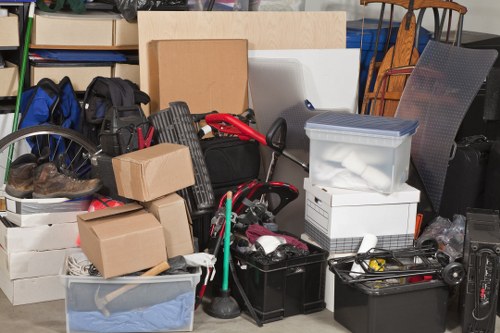
Some of the more time-consuming clearances are not large in volume but awkward in layout. Attics, cellars, narrow staircases and properties with limited parking can all affect how a clearance is organised. The same applies to homes with items stored in several disconnected places, because the work may need to be staged room by room. In those cases, a clear understanding of the route through the property is as important as the contents themselves.
We can also help where a property contains a long-standing mix of stored belongings rather than a neat set of furniture. Boxes, bags, old household stock, hobby materials and miscellaneous storage can take time to identify and move safely. If you want to keep certain items, it is best to separate them before the clearance begins. If not, the work can focus on removing the full collection efficiently and without confusion.
For customers wanting to compare the different residential services, the pages for home clearance, house clearance and flat clearance give useful context. If you are ready to move forward, ask for a quotation and outline the rooms, the main items and the access. That simple step is enough to begin, and it keeps the process focused on the service you actually need.
More than one way to clear a property responsibly
Not every customer needs the same combination of services, and that is why related pages can be helpful when planning a job. A household may need a full clearance, while another property only needs a few heavy pieces removed and a garage emptied. In some cases, the right solution is to combine domestic item removal with a separate waste clearance so that the contents are handled according to what they are, rather than forcing them into one broad description.
The pages for waste removal, furniture disposal and garage clearance can help when the property contains mixed material and not just standard household furniture. They are useful when you want to understand how the various types of removal differ in scope. The important thing is to match the service to the actual contents, which keeps the work more practical and less wasteful.
If you would like a quotation, contact us with a brief description of the property and the items involved. You can keep it simple and still be specific enough for a useful reply. The clearer the brief, the easier it is to plan the clearance properly, especially when several rooms or item types are involved.
Ask for a quotation
Barking House Clearance provides a practical, well-organised service for removing household contents, furniture, loft items, garage clutter and related waste in Barking. Whether the job is a full house clearance or a smaller clearance of selected rooms, the work is shaped around the property and the items that need to go. If you are comparing service options, the relevant pages linked above can help you decide which type of removal fits best.
When you are ready, ask for a quotation and give a short outline of the rooms, the kinds of items and any access points that matter. If you prefer, note any furniture that must stay, any bulky pieces that need special handling and any items that should be separated. A concise description is usually enough to start the process, and it helps keep the clearance focused on what you actually need done.
For the final step, send through the details and request a quotation.