Recycling and Sustainability at Barking House Clearance
At Barking House Clearance we place eco-friendly waste disposal and sustainable rubbish management at the core of every job. Our approach to waste minimisation and resource recovery reflects both local priorities and broader environmental goals. We work to reduce landfill dependency, increase material reuse and ensure that every house clearance in Barking and neighbouring boroughs follows a clear, documented path from collection to recycling or ethical disposal. This page explains our targets, local partnerships, and the practical steps we take to offer an environmentally responsible house clearance service.Our recycling percentage target and performance
We have set an ambitious but achievable target of diverting 80% of all collected waste from landfill by the end of 2026, with ongoing improvements toward a long-term aim of 90% reuse or recycling. To reach these goals we monitor outputs from each job, categorise materials on-site and at transfer facilities, and report monthly on our diversion rates. Our tracking makes sure clients know how their items were processed, and local authorities value the clear metrics that demonstrate reduced carbon and landfill impact.
How we sort and the kinds of recycling activity we support
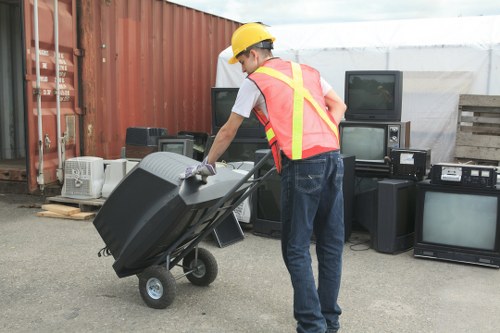
We follow the boroughs' approach to waste separation where possible: dry recycling streams (paper, cardboard, glass), separate food and garden collections, and designated routes for bulky items and WEEE. Our crews segregate materials during collection so that suitable items go to reuse centres or charities and recyclable fractions are routed to specialist processors. We routinely handle:- WEEE (electricals and electronics) for certified recycling and data-safe disposal;
- Furniture and textiles for refurbishment and donation to community projects;
- Metals, timber and inert materials for recovery and reuse by local recyclers;
- White goods and appliances sent to recycling lines that recover refrigerants and metals.
 We partner closely with local transfer stations and material recovery facilities to ensure correct processing. Where possible we use transfer stations operated or authorised by the East London Waste Authority (ELWA) and nearby municipal facilities in Newham and Havering. These stations provide the capacity to sort, weigh and dispatch loads to the most appropriate end point, whether that is a reuse centre, specialist WEEE recycler, or a shredder for timber and construction waste.
Our systems are designed to integrate with community-led reuse schemes: donations pass through quality checks and refurbishment pathways so that goods have a second life. We prioritise reuse before recycling, sending usable items to charities and social enterprises that create local benefit and reduce raw material demand.
We maintain formal partnerships with national and local charities to maximise the reuse of items recovered from house clearances. These include established organisations such as Emmaus and the British Heart Foundation, along with smaller community furniture projects and homelessness charities that operate within Barking and neighbouring boroughs. Donated items are logged and accompanied by basic condition notes so partners can accept and redistribute them quickly.
 To support sustainable rubbish management we operate a dedicated logistics chain: items intended for reuse are transported directly to charity partners or community reuse centres, hazardous materials and WEEE are taken to certified processors, and bulk inert waste is sent to licensed aggregates and composting facilities. This ensures regulatory compliance and reduces the environmental footprint of each clearance job.
 Our vehicle fleet includes low-carbon vans — electric and hybrid models — used on shorter urban routes to cut emissions inside the London Low Emission Zone and across Barking. We schedule pickups to maximise load consolidation and use route-optimisation software to minimise miles driven. This combination of low-emission vehicles, smart routing and high recycling targets turns each clearance into a lower-carbon operation compared with traditional, landfill-focused services.
We also invest in staff training so crews can identify salvageable materials on-site, recognise hazardous wastes and segregate efficiently. Clear labelling, photographic records and consistent procedures mean our recycling percentage is not an estimate but an auditable figure. Clients receive a breakdown of materials recovered and a statement summarising how their waste was handled.
Beyond immediate logistics, Barking House Clearance supports circular economy principles: we favour repair, refurbishment and resale where practical, divert organics to local composting schemes, and work with metal and timber processors that prioritise recycled feedstock. Our procurement choices favour local reprocessors to reduce transport emissions and support the regional recycling ecosystem.
Choosing an eco-friendly house clearance service matters. By selecting a provider committed to sustainable rubbish solutions, low-carbon vans, and charity partnerships you help increase reuse, reduce landfill and lower community emissions. Barking House Clearance's measurable targets, local transfer station links and collaborative approach make us a practical choice for anyone in the area seeking responsible, environmentally sound removal of household and bulky waste.